
1. Introduction
When building modern web applications, choosing the right technology for the user interface plays a crucial role in the success of a project. Two of the most popular options today are React and Next.js, each offering different strengths and serving different purposes.
The decision between React and Next.js depends on several factors, including project requirements, performance expectations, SEO needs, and long-term scalability. In this article, we'll explore the advantages and limitations of both technologies to help you make the right decision for your next project.
2. React – A Powerful and Flexible UI Library

2.1 What is React?
React is an open-source JavaScript library developed by Facebook (Meta) for building user interfaces. One of React's core strengths is its component-based architecture, which allows developers to create reusable UI components and maintain large-scale applications more efficiently.
2.2 Benefits of React
High Flexibility
React does not enforce a specific application structure, allowing developers to organize their projects however they prefer. This flexibility provides maximum freedom but also requires experience to maintain a clean and scalable codebase.
Developers can choose their own routing solution, state management library, API handling strategy, and project architecture based on their requirements.
Reusable Components
React encourages developers to break applications into smaller, reusable components. This approach improves maintainability, reduces duplication, and makes it easier to scale applications over time.
Virtual DOM
One of React's biggest strengths is the Virtual DOM, which helps optimize rendering performance by minimizing direct manipulation of the browser's DOM. As a result, UI updates become more efficient compared to traditional rendering approaches.
Easy Integration
After building a React application, the output can be deployed as static assets (HTML, CSS, and JavaScript). This makes React easy to integrate with existing backend systems such as FastAPI, Express, NestJS, Spring Boot, or .NET applications.
For teams that already have an established backend architecture, React can serve as a lightweight frontend layer without requiring an additional frontend server.
Large Community and Rich Ecosystem
React has one of the largest communities in the frontend ecosystem. Developers have access to thousands of libraries, tutorials, courses, and open-source projects covering everything from UI components to state management and API integration.
This extensive ecosystem makes React relatively easy to learn and adopt, regardless of experience level.
2.3 Limitations of React
More Initial Setup
React is a UI library rather than a full-featured framework. As a result, developers often need to configure additional tools for routing, state management, data fetching, authentication, and other common application requirements.
SEO Limitations
React applications typically rely on Client-Side Rendering (CSR), which may not provide the best SEO experience compared to Server-Side Rendering (SSR) or Static Site Generation (SSG).
While there are solutions available to improve SEO, such as prerendering or framework-based rendering strategies, these capabilities are not included in React itself.
3. Next.js – Better SEO and Performance Out of the Box

3.1 What is Next.js?
Next.js is a React framework developed by Vercel that provides advanced capabilities such as Server-Side Rendering (SSR), Static Site Generation (SSG), React Server Components, caching strategies, and image optimization.
The primary goal of Next.js is to simplify React application development by offering built-in solutions for common challenges that developers would otherwise need to implement manually.
3.2 Benefits of Next.js
Server-Side Rendering (SSR)
SSR allows pages to be rendered on the server before being sent to the browser.
This approach delivers fully rendered HTML to users immediately, improving the initial page load experience and making content easier for search engines to index.
Applications still download JavaScript for hydration and client-side interactivity, but users can see meaningful content much sooner.
Static Site Generation (SSG)
Next.js can generate static pages during the build process, resulting in extremely fast page load times.
This approach is ideal for blogs, landing pages, documentation sites, and product pages where content changes infrequently.
In modern versions of Next.js, SSG works together with caching and revalidation mechanisms, allowing content updates without sacrificing performance.
File-Based Routing
Next.js includes a built-in routing system based on the file structure of your project.
With the App Router, developers can easily organize pages, layouts, loading states, error boundaries, and nested routes without additional configuration.
This significantly reduces the amount of boilerplate code required compared to a traditional React setup.
API Routes
Next.js allows developers to create API endpoints directly inside the application.
This can be useful for small to medium-sized projects where maintaining a separate backend service may be unnecessary.
However, for large-scale backend systems, dedicated backend frameworks such as NestJS, Express, FastAPI, or Spring Boot are still common choices.
React Server Components (RSC)
One of the most significant advantages of modern Next.js is support for React Server Components.
By rendering components on the server by default, Next.js can reduce the amount of JavaScript sent to the browser, improving performance and reducing client-side processing.
This is particularly beneficial for content-heavy applications that do not require extensive client-side interactivity.
Built-in Image Optimization
Next.js provides the Image component, which automatically optimizes images, generates responsive sizes, and supports modern image formats such as WebP and AVIF.
This helps reduce bandwidth usage and improve page loading speed across different devices.
3.3 Limitations of Next.js
Less Flexible Than React
While Next.js provides many built-in features, it also introduces conventions and architectural decisions that may feel restrictive for some projects.
For smaller applications that do not require SSR, SSG, or Server Components, a plain React setup may be simpler.
Increased Complexity
To fully utilize Next.js, developers often need to understand concepts such as:
React Server Components
Server Actions
Caching
Revalidation
Parallel Routes
Intercepting Routes
File Conventions
These concepts introduce additional learning overhead compared to React alone.
More Complex Deployment
Because Next.js supports multiple rendering strategies and server-side functionality, deployment can be more complex than a standard React SPA.
Build times may also increase as applications grow in size and complexity.
4. When Should You Choose React? When Should You Choose Next.js?
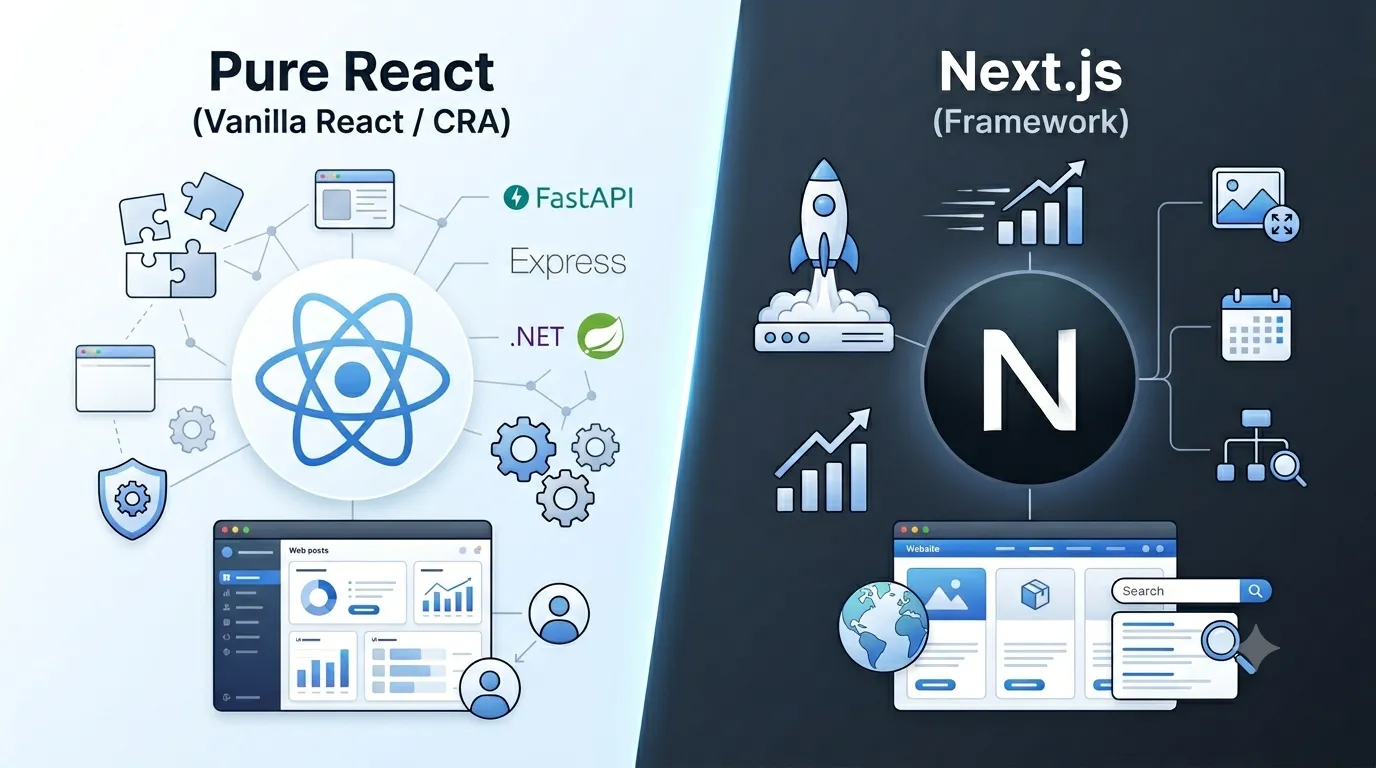
4.1 Choose React When
You are learning React fundamentals and want to understand concepts such as components, props, state, and hooks.
You need maximum flexibility in project architecture.
You want to integrate a frontend into an existing backend system.
SEO is not a major concern.
You are building a highly interactive Single Page Application (SPA).
You are developing internal dashboards, admin panels, or business applications where search engine visibility is not important.
4.2 Choose Next.js When
SEO is a critical requirement.
You want faster initial page loads through SSR and SSG.
You want to leverage React Server Components.
Your application contains content-heavy pages such as blogs, landing pages, or product pages.
You prefer a framework with built-in routing, API routes, image optimization, caching, and rendering strategies.
You want to reduce development time by using established conventions and best practices.
5. Conclusion
The most important factor is understanding your project's requirements before selecting a technology.
If you need maximum flexibility and are building interactive applications where SEO is not a priority, React remains an excellent choice.
On the other hand, if SEO, performance, server-side rendering, and modern React capabilities are important to your project, Next.js provides a more complete solution out of the box.
These observations are based on practical experience using React 19 and Next.js 16 at the time of writing. As both technologies continue to evolve, some recommendations may change in future releases.